


Most businesses wait too long to build a mobile app. By the time they act, a competitor already owns their customer’s home screen. This guide covers what mobile apps for business actually deliver, from revenue and retention to data and competitive advantage, and what it costs you every day you do not have one.
Customer expectations have changed permanently. They no longer wait until they get home to browse, buy, or get support. They do it from their pocket, in real time, on their terms. Businesses that have not caught up are already losing ground.
Mobile is not a secondary channel anymore. It is where your customers spend the majority of their time. For most people, a smartphone is the first screen they check in the morning and the last one they look at before bed.
This guide breaks down exactly what mobile apps for business deliver, from customer engagement and revenue growth to data, operations, and competitive advantage. If you are still on the fence about building an app, what follows will make the decision clear.
Why Mobile Apps for Business Are No Longer Optional
The numbers are not debatable. Smartphone penetration has crossed 90 percent in most developed markets. Your customers are on their phones for an average of four hours a day. The question is no longer whether mobile matters. It is whether your business shows up when it does.
- Smartphone usage exceeds 90 percent in most markets
- Mobile accounts for over 60 percent of global web traffic
- Customers spend 90 percent of mobile time inside apps, not browsers
- Businesses without apps lose customers to those that have them
Customer behavior has shifted in one direction and it is not reversing. People expect instant access, frictionless service, and personalised experiences. A mobile website no longer meets that bar. It is a compromise. An app is a commitment to the customer experience they actually want.
The cost of not having an app is real. Every time a customer reaches for their phone to find a service you offer and lands on a competitor’s app instead, that is a lost sale. Furthermore, it is a lost relationship. Businesses that treat mobile apps for business as optional are not playing it safe. They are falling behind.
How Mobile Apps for Business Drive Customer Engagement
A mobile website gets visited. A mobile app gets used. That distinction matters more than most business owners realise. Apps create a direct, persistent connection between your brand and your customer. Here is how that connection drives engagement.
Push Notifications Open a Direct Line
No algorithm, no inbox competition, no waiting. A push notification lands directly on your customer’s screen. Used well, it is the most effective direct communication tool available to any business today.
Personalised Experiences Keep Customers Coming Back
Apps learn from user behavior. Every tap, search, and purchase tells you something. That data allows you to serve content, offers, and recommendations that feel personal rather than generic, which keeps users engaged far longer.
Built-in Loyalty Programs Reward the Right Behavior
An app makes it easy to reward customers for repeat purchases, referrals, and engagement. When the loyalty program lives inside the app, participation increases because the friction of carrying a card or remembering a code disappears entirely.
Apps Outperform Mobile Websites on Every Metric
Load speed, session length, conversion rate, and return visits — apps win on all of them. A mobile website is a fallback. An app is an experience built specifically for the customer.
Consistent Engagement Builds Customer Loyalty
Engagement is not a one-time event. It is a habit. When your app becomes part of a customer’s daily routine, customer loyalty follows naturally and compounds over time.
The Revenue Impact of Mobile Apps for Business
An app is not a marketing tool. It is a revenue engine. Businesses that invest in a well-built app directly increase what customers spend, how often they return, and how long they stay.
In-app purchasing removes every barrier between intent and transaction. No form filling, no redirects, no abandoned carts. When buying is effortless, more customers follow through and average order values climb.
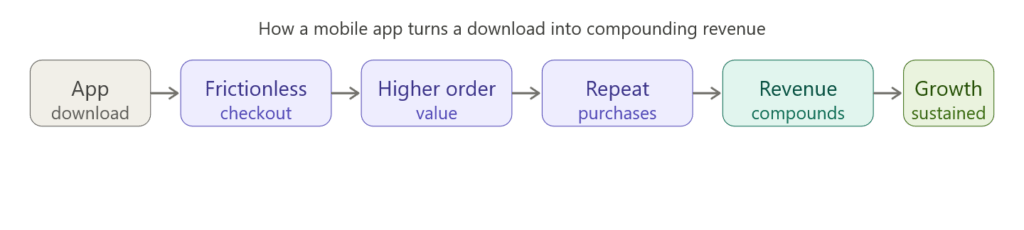
Retention tells the same story. Customers who engage through an app return more often, spend more per visit, and cost less to keep. Mobile commerce data confirms this trend is accelerating, not slowing down.
Every improvement to the app experience drives growth across the entire business. Better retention, higher order values, and lower friction create a compounding effect that builds real financial momentum over time.
Streamlining Operations With Mobile Apps for Business
Most business owners think of apps as customer-facing tools. That is only half the picture. A well-built app streamlines what happens behind the scenes just as much as what the customer sees. Here is where the operational gains show up.
- Internal and customer-facing app functions
- Booking and scheduling automation
- Support handled without human intervention
- Reduced manual workload across the business
- Integration with your existing business tools
The before and after is stark. Businesses that relied on phone calls, email chains, and spreadsheets to manage bookings, payments, and support are now handling all of it inside one app. The time saved is not marginal. It is hours every day across every department.
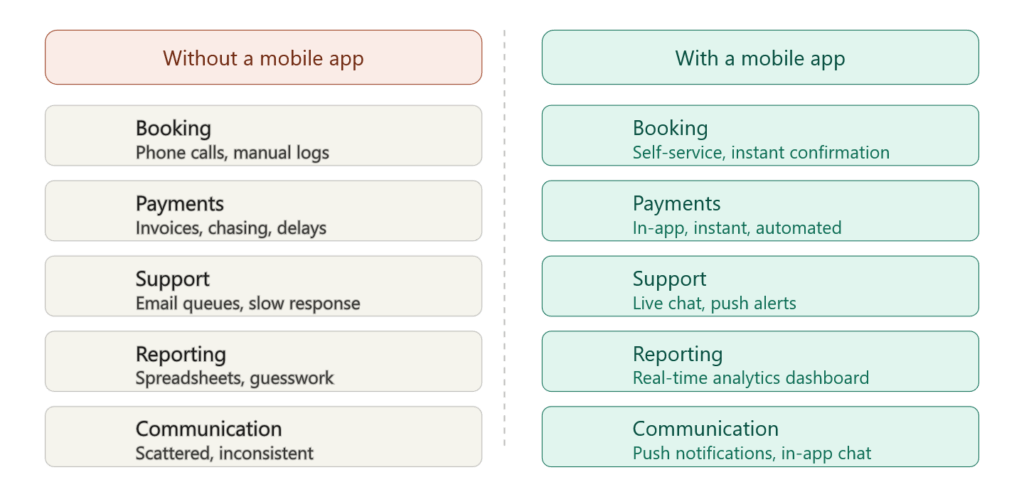
Integration is where the real efficiency lives. A mobile app that connects to your CRM, accounting software, and inventory system eliminates double entry and human error. Furthermore, your team stops switching between platforms and starts working from a single source of truth.
The result is a leaner operation. Fewer manual tasks mean fewer mistakes, lower staffing costs, and more time focused on growth rather than administration.
Data and Insights You Only Get From an App
A website tells you what page someone visited. An app tells you everything else. How long they stayed, what they tapped, where they dropped off, and what brought them back. That level of detail changes how you run your business.
User behavior inside an app reveals patterns no other channel can match. Purchase sequences, peak engagement times, and feature usage all become visible. Consequently, you stop guessing what your customers want and start knowing.
That data feeds directly into the customer experience. When you know what works and what does not, every update to the app becomes a deliberate improvement rather than a shot in the dark.
The real payoff is in your marketing decisions. App analytics tells you which campaigns drive the most engaged users, not just the most clicks. That distinction is worth more than any advertising budget increase.
Mobile Apps for Business Give You a Competitive Edge
Customers judge your business by how easy it is to deal with. An app signals that you take their time seriously. It positions your brand as modern, capable, and customer-first. That perception alone separates you from competitors still relying on outdated channels.
First-mover advantage is real. In most local and niche markets, the first business with a well-built app owns the customer’s home screen. That is valuable real estate. Every day a competitor gets there before you is a day of lost brand equity you cannot recover.
The businesses building the strongest long-term brands right now are investing in digital experiences that compound over time. A well-built app is one of the clearest expressions of that strategy. As HBR notes, sustaining a competitive edge requires consistent investment in what your customers value most.
How to Know If Your Business Is Ready for a Mobile App
Not every business needs an app on day one. But most businesses are further along than they think. The signs are usually already there. Here is how to read them.
Your Customers Are Already on Their Phones
If your customers book, browse, or buy through a mobile browser, an app will serve them better. Slow load times and poor mobile experiences are costing you conversions right now.
Your Operations Have Outgrown Your Current Tools
If your team manages bookings, payments, or customer communication across multiple platforms, an app consolidates everything. The inefficiency you are tolerating has a real cost.
Your Budget Can Support It
A basic but well-built app starts from a few thousand pounds. A full-featured app costs more. Therefore, set a realistic budget before you start and build to that scope rather than cutting corners on something customers will interact with daily.
You Have a Clear Version One
The biggest mistake businesses make is trying to build everything at once. Start with the one or two features your customers need most. Launch fast, gather feedback, and improve from there.
You Know Whether to Build, Buy or Use a Platform
Custom builds offer the most control but cost the most. App platforms like Shopify or Glofox offer faster, cheaper entry points for specific industries. Furthermore, knowing which route fits your business before you start saves months of wasted time and money.
Your Customers Are on Their Phones. Are You?
Every day without a mobile app is a day your competitor has an advantage you do not. The businesses winning right now are not waiting for the perfect moment. They are building, launching, and improving.
A well-built app drives customer engagement, increases revenue, streamlines operations, and gives you data that makes every business decision sharper. Those are not marginal gains. They are structural advantages that compound over time.
The best time to build was last year. The next best time is now. Take the first step and put your business in your customer’s pocket.
Frequently Asked Questions: Mobile Apps for Business
A basic business app starts from a few thousand pounds. A full-featured custom build can cost significantly more depending on complexity. App platforms and white-label solutions offer a faster, cheaper entry point for businesses that do not need a fully bespoke product.
Yes, if their customers are already using mobile to browse, book, or buy. A mobile app improves the customer experience, increases repeat business, and gives small businesses a competitive edge that was previously only available to larger brands.
The main benefits include increased customer engagement, higher revenue through frictionless purchasing, streamlined operations, valuable behavioural data, and a stronger competitive position. Together these advantages compound over time and build long-term brand equity.
A simple app takes three to six months to build. A more complex custom build can take nine to twelve months or longer. Using an app platform or white-label solution can reduce that timeline significantly depending on the features required.