


Most UK businesses focus on the same tired tactics and wonder why growth stalls. The strategies that actually work are often the ones being ignored. This guide covers the business growth strategies overlooked by most UK small businesses in 2026, and shows you exactly how to use them to expand, compete, and win.
Most UK businesses follow the same growth playbook. They run ads, chase new customers, and wonder why revenue stays flat. The problem is not effort. It is strategy.
The business growth strategies that actually move the needle are rarely the obvious ones. Market penetration, strategic partnerships, customer retention and brand authority consistently outperform paid acquisition yet most small business owners overlook them entirely.
This guide cuts through the noise. Whether you run a five-person operation in Manchester or a growing agency in London, these are the business growth strategies that UK businesses ignore in 2026 and exactly how to start using them today.
Why Most UK Businesses Get Business Growth Strategies Wrong
The UK has 5.7 million private sector businesses. Most of them are small. Most of them are also making the same strategic mistakes.
The common errors include:
- Chasing new customers before retaining existing ones
- Spending on ads before fixing the core offer
- Copying competitors instead of identifying gaps
- Ignoring brand authority in favour of short-term tactics
- Treating growth as a marketing problem rather than a business problem
Growth stalls when strategy is reactive. Most UK small business owners respond to slow months by increasing ad spend or launching promotions. Neither addresses the root cause.
The businesses that grow consistently do the opposite. They audit what is already working, double down on it, and build systems around it. According to the House of Commons Library, there are 5.7 million private sector businesses in the UK. The ones that scale share one trait: intentional strategy over reactive spending.
Getting business growth strategies right starts with honestly assessing where your business currently stands.

The Market Penetration Strategy
Most small business owners think growth means finding new customers. It rarely does. The fastest route to revenue is sitting inside the market you already serve.
Market penetration means selling more to the people who already know you. It sounds simple because it is. Yet most UK businesses skip it entirely and head straight for expensive acquisition campaigns.
Your existing customers already trust you. They have bought from you before. Convincing them to buy again costs a fraction of what it costs to win someone new. Loyalty programmes, personalised follow-ups, and targeted offers to past buyers can lift revenue without a single new lead.
Before you spend another penny on advertising, read our guide on running ads. It covers exactly why penetrating your current market first is the smartest move a UK small business can make in 2026.
How Strategic Partnerships Drive Faster Growth Than Paid Ads
Paid ads stop working the moment you stop paying. Strategic partnerships compound over time. For UK small businesses facing rising costs and tighter margins, collaboration is one of the most overlooked and most effective business growth strategies available today. The Federation of Small Businesses consistently shows that SMEs cite limited resources as their biggest barrier to growth. Partnerships directly solve that problem.
Referral Partnerships
Find businesses that serve your target customer but do not compete with you. A web designer partnering with a copywriter is a simple example. Both send clients to each other. Both grow without spending on ads.
Co-Marketing Campaigns
Two businesses sharing an audience can split the cost of a campaign and double the reach. Email newsletters, joint webinars, and shared social content all work well here.
Supplier Relationships
Strong supplier relationships often unlock better terms, priority stock, and exclusive deals. These advantages translate directly into competitive pricing and faster fulfilment.
Distribution Partnerships
Partner with a business that already has access to your ideal customer. Let them distribute or recommend your product or service in exchange for a commission or reciprocal arrangement.
White Label Agreements
Offer your services under another company’s brand or sell theirs under yours. This expands your offering without expanding your team.
Business Growth Strategies Hidden Inside Your Existing Customer Base
Most UK businesses are sitting on untapped revenue and do not realise it. Your existing customers are your most valuable growth asset. They already trust you, they have already bought from you, and they are far more likely to buy again than a cold prospect ever will be.
Upselling
Identify customers on your entry level product or service and offer them a clear upgrade path. Show them the tangible benefit of moving up. Keep the ask simple and the value obvious.
Cross-Selling
Look at what your customers buy and identify what else they need. If you offer web design, your client likely needs SEO. If you sell accounting software, they probably need payroll support. Connect the dots for them.
Loyalty Programmes
Rewarding repeat business increases purchase frequency. It does not need to be complex. A simple points system, an exclusive discount for returning clients, or early access to new services all work effectively.
Feedback Loops
Ask customers what they wish you offered. Their answers will tell you exactly where your next revenue stream is. Most businesses never ask. The ones that do grow faster.
Re-engagement Campaigns
Identify customers who have gone quiet. A targeted email, a personal phone call, or a tailored offer can reactivate relationships that still have genuine value.
For a deeper look at how continuous improvement drives retention, read our guide on improving your business.
How to Expand Without Big Budgets
Expansion does not require deep pockets. It requires clear thinking and the right sequence of moves. According to GOV.UK, there are 5.7 million private sector businesses in the UK. The market is large. The opportunity to carve out a bigger slice of it is real, even on a limited budget.
Target Adjacent Customer Segments
Look at who is buying from you and identify similar groups you are not yet serving. A small shift in messaging or packaging can open an entirely new segment without changing your core offer.
Expand Geographically Online
A strong SEO strategy and targeted content can position your business in front of customers in other UK regions or internationally. You do not need a physical presence to compete in new locations.
Launch a Complementary Service
Analyse what your customers need before and after they work with you. Building a complementary service captures more of their spending and extends your relationship with them.
Leverage E-Commerce
If your business is service based, consider productising part of your offering. Templates, toolkits, online courses, and digital downloads create scalable revenue streams with minimal overhead.
Use Content to Enter New Markets
Publishing targeted content for a new audience builds visibility before you invest in that market. It is low cost, measurable, and compounds over time.
Build Brand Authority With Business Growth Strategies
Brand authority is not built overnight. It is built through consistency, credibility, and a clear point of view that your target market recognises and trusts over time.
Most UK small businesses underinvest in brand authority because the returns are not immediate. That is precisely why it remains one of the most overlooked business growth strategies available. While competitors chase short term wins, businesses that invest in authority build something competitors cannot easily copy.
Thought leadership content, consistent visual identity, industry press coverage, and client case studies all contribute to authority. Each asset you create adds to the next. The compounding effect is significant over a twelve to twenty four month period.
The businesses that dominate their sectors in the UK are rarely the ones with the biggest budgets. They are the ones with the strongest reputations. Read our guide on building a successful business to understand the foundations that make brand authority possible and sustainable.

Franchising, Licensing and Acquisition
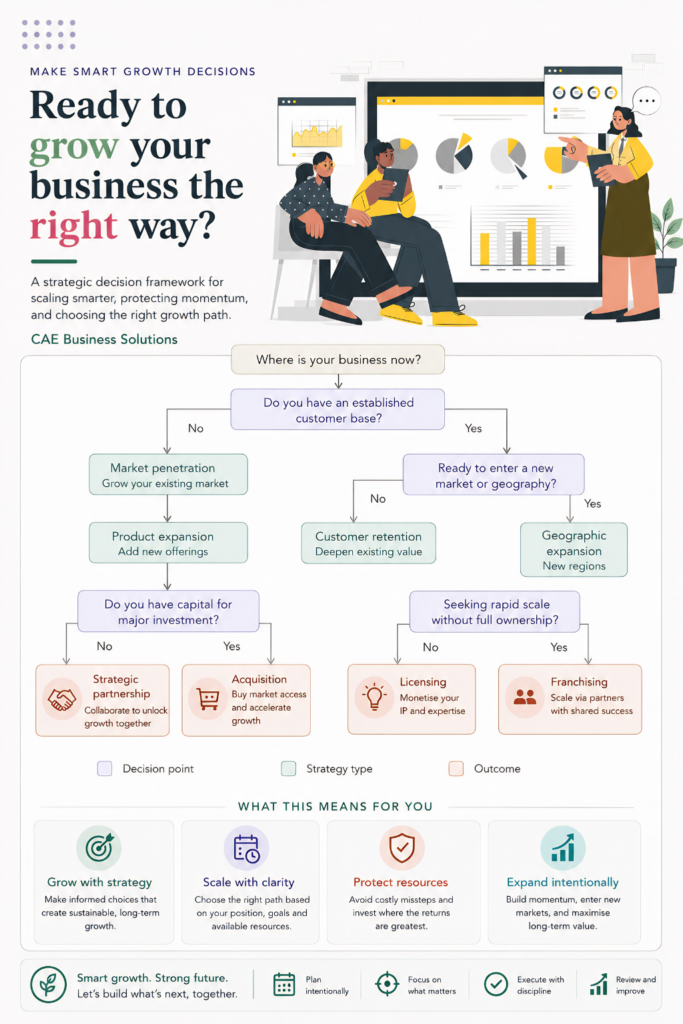
Not every growth strategy is gradual. At a certain point, some UK businesses need to make bigger moves to reach the next level. Franchising, licensing, and acquisition are three routes that can accelerate scale significantly when the timing and foundations are right.
The key indicators that you are ready include:
- A proven, repeatable business model
- Documented systems and processes
- Consistent profit margins over at least two years
- A strong brand with clear market positioning
- The management capacity to oversee expanded operations
Franchising allows you to grow your brand footprint without funding every new location yourself. You leverage the capital and effort of motivated franchisees while maintaining brand standards through training and operational frameworks.
Licensing your intellectual property, whether a product, methodology, or technology, generates revenue without the overhead of direct delivery. It is a particularly effective strategy for businesses with proprietary systems or strong brand recognition.
Acquisition accelerates growth by buying what would otherwise take years to build. An acquired business brings customers, revenue, talent, and market presence from day one. The due diligence process is critical but the rewards for getting it right are substantial.
Your Next Move Decides Everything
Most UK businesses will read this guide and do nothing. That is why the gap between businesses that grow and businesses that stagnate keeps widening every year.
The business growth strategies covered here are not complicated. They are overlooked. Market penetration, strategic partnerships, customer retention, brand authority and bold scaling moves are all available to you right now without a massive budget.
Pick one strategy. Execute it fully. Then build the next. Consistent action on the right strategies is what separates growing UK businesses from ones that flatline.

Frequently Asked Questions About Business Growth Strategies
The most effective strategies focus on what you already have. Market penetration, customer retention, strategic partnerships, and brand authority consistently outperform paid acquisition for UK SMEs with limited budgets.
Start with your existing customers. Upsell, cross-sell, and re-engage lapsed clients. Build referral partnerships with complementary businesses. These approaches generate revenue without significant additional spend.
When you have a proven model, consistent profit margins, documented systems, and the management capacity to oversee growth. Scaling through acquisition or franchising without these foundations in place rarely ends well.
Paid tactics can show results within weeks. Organic strategies like brand authority and content marketing typically take three to six months to gain traction but compound significantly over time.