


Most UK startups fail not because the idea was wrong but because the foundations were never built correctly. Knowing how to build a successful business in 2026 means getting your brand, strategy and financial discipline right before a single penny goes into advertising. This guide covers exactly what to fix, what to build and what to stop doing.
Most UK startups do not fail because of bad ideas. They fail because the business was never properly built. The vision was there. The foundations were not.
Knowing how to build a successful business means making strategic decisions before the market forces your hand. Brand, positioning, financial discipline and digital presence are not optional extras. They are the difference between a business that survives and one that scales.
This guide covers every critical stage of that journey. Whether you are starting a business from scratch or rebuilding what already exists, the principles here apply directly to where you are right now.
Start With Vision Not Products
Most founders start with a product. The ones who build lasting businesses start with a purpose. That distinction separates the companies that scale from the ones that stall within three years of launch.
Vision is not a mission statement written for a pitch deck. It is the internal compass that drives every decision your business makes. Who you serve, what you stand for, and where you want to be five years from now. Without it, every decision becomes reactive.
Businesses that endure answer one question clearly. Why does this business exist beyond making money? That answer shapes your brand, your hiring, your marketing and your customer relationships before you sell a single product.
Before you research how to start a business, define what success genuinely looks like for you. Everything else follows from that.
The Brand Foundation Every UK Startup Gets Wrong
Most UK startups underinvest in brand and overspend on advertising. They run campaigns before anyone knows who they are, what they stand for, or why they are worth choosing. The result is predictable. High spend, low return, and a business that looks like every competitor in the market.
A strong brand foundation covers:
- Brand vision and core values
- Target audience definition
- Unique value proposition
- Visual identity and logo
- Brand voice and tone
- Consistent messaging across all platforms
- Professional photography and imagery
Your visual identity forms the first impression your business makes online. A weak logo, inconsistent colours and poor imagery tell prospects your business cuts corners. That judgment forms in seconds and it is almost always final.
Your value proposition decides whether a visitor stays or leaves. It must answer one question immediately. Why should I choose you over everyone else? Generic answers lose business every single day.
Brands that invest in these foundations before running a single ad consistently outperform those that do not. Getting this right is not a cost. It is the highest return decision any UK startup makes in its first year.
How to Build a Successful Business Plan That Attracts Investment
A business plan is not a formality. Instead, it is the document that forces you to stress test every assumption about your market, your model and your money before reality does it for you. Investors and lenders read hundreds of plans. Ultimately, the ones that attract funding are built on clarity, evidence and commercial logic.
Define Your Business Model With Precision
First, state clearly how your business makes money, who pays, how often and why they will keep paying. Vague revenue models destroy credibility before the second page.
Know Your Market With Data Not Assumptions
Next, quantify your target market, identify your competitors and demonstrate that demand exists. Opinions do not attract investment. Research does.
Build Realistic Financial Projections
In addition, show three year projections covering revenue, expenses, cash flow and break even point. Overly optimistic numbers signal inexperience. However, conservative figures backed by logic signal commercial maturity.
Present a Clear Growth Roadmap
Finally, investors back businesses with direction. Therefore, outline your key milestones, what funding achieves and how you measure progress at every stage. Pair this with proven business growth strategies that demonstrate you understand how to scale beyond the initial launch phase.
A strong business plan does not guarantee investment. Nevertheless, it does guarantee that every decision your business makes in the first two years stays grounded in strategy rather than impulse.
Know Your Market Before You Spend a Single Penny
Every pound spent on marketing without a clearly defined audience is a pound wasted. Most UK startups describe their target market as everyone. That is the first sign a business is not ready to grow.
Market research does not require a large budget. Instead, it requires discipline and honesty. Talk to real customers. Study your competitors. Analyse what the market rewards and what it consistently ignores. The answers are already out there.
Understanding your audience shapes everything that follows. Consequently, your website copy, your pricing, your service offering and your advertising all perform better when they speak directly to a specific person with a specific problem.
The businesses that grow fastest are not the ones with the biggest budgets. They are the ones that understand their customer better than anyone else in their market. That knowledge costs nothing but time.
How to Build a Successful Business Through Smart Financial Discipline
Most startups do not fail because they lack customers. They fail because they run out of money before those customers arrive. Financial discipline is therefore not an accounting function. It is a survival strategy that every founder must take seriously from the very first day.
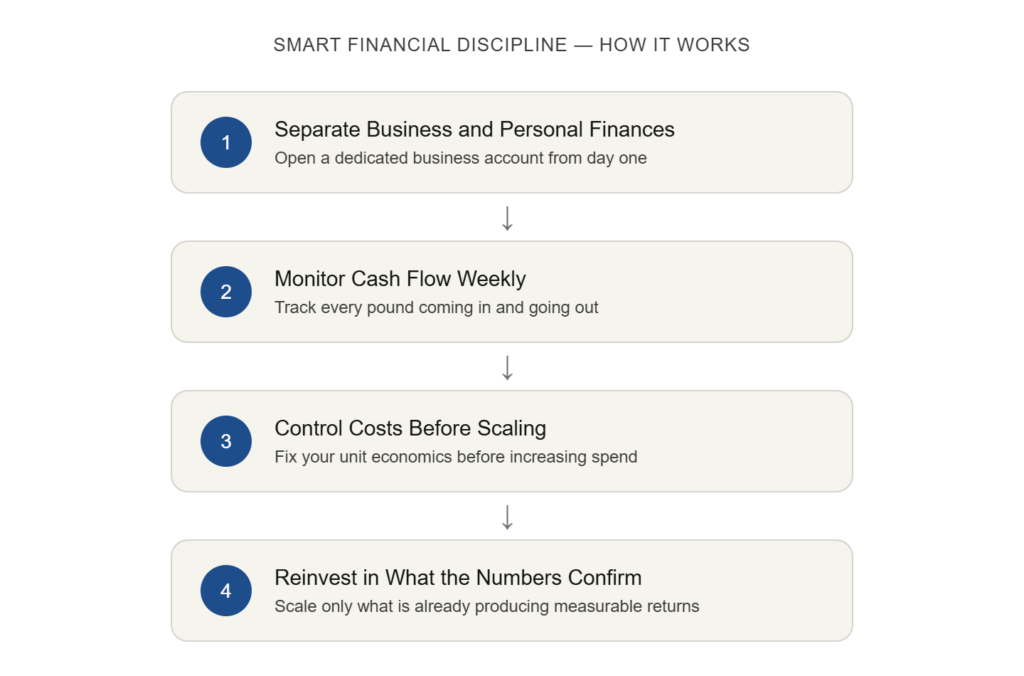
Separate Business and Personal Finances Immediately
Open a dedicated business account before you take your first payment. Mixing personal and business finances creates confusion, complicates tax returns and signals to lenders that your business lacks structure.
Monitor Cash Flow Weekly Not Monthly
Revenue figures lie. Cash flow tells the truth. Consequently, knowing exactly what comes in and goes out every week gives you the visibility to make decisions before problems become crises.
Control Your Costs Before You Scale
Scaling a business with poor unit economics accelerates losses rather than profits. Therefore, fix your cost base, understand your margins and ensure each product or service is genuinely profitable before you increase spend.
Reinvest Only in What the Numbers Confirm
Gut feeling is not a financial strategy. Furthermore, every reinvestment decision should follow the data. Double down on what produces measurable returns and cut what does not, regardless of how much it cost to build.
Effective strategic financial management is ultimately what separates founders who scale confidently from those who constantly scramble. The numbers always tell the story before the market does.
Marketing, SEO and Digital Strategy for UK Founders in 2026
UK founders who treat marketing as an afterthought consistently lose ground to competitors who treat it as infrastructure. In 2026, your digital presence is your first sales meeting. Most prospects have already formed an opinion before they ever contact you.
A strong digital strategy covers:
- Search engine optimisation
- Content marketing and blogging
- Social media presence
- Google Business Profile
- Email marketing
- Pay per click advertising
- Website conversion optimisation
SEO remains the highest return digital channel available to UK startups. Unlike paid advertising, it compounds over time and continues generating traffic long after the work is done. Founders who invest in top SEO tactics for business owners early build an audience that no budget cut can erase overnight.
Content marketing works alongside SEO to build trust before a prospect ever reaches your sales page. Consequently, businesses that publish consistent, well structured content rank higher, convert better and spend significantly less on paid acquisition over time.
Digital strategy is not about being everywhere. It is about showing up consistently in the right places for the right audience at the right moment.
How to Build a Successful Business That Retains Customers and Growth
Acquisition gets the attention. Retention builds the business. Most UK founders pour budget into winning new customers while systematically neglecting the ones they already have. That imbalance is expensive. Retaining an existing customer costs significantly less than acquiring a new one, and loyal customers spend more, refer others and reduce your dependence on paid advertising over time.
Deliver Beyond the Initial Transaction
The sale is not the finish line. It is the starting point of a relationship that either compounds in value or quietly disappears. Therefore, build a post sale experience that makes clients feel the decision to choose you was the right one.
Build Structured Follow Up Systems
Most businesses lose clients not through bad service but through silence. Consequently, create structured touchpoints after every project or purchase. A simple follow up sequence builds loyalty more effectively than any discount or incentive ever will.
Turn Satisfied Clients Into Active Referrers
A satisfied client who never refers is a missed opportunity. Furthermore, make referrals easy by asking directly, creating referral incentives and acknowledging every introduction your clients send your way. Word of mouth remains the most trusted channel in any market.
Measure Retention as Seriously as Acquisition
Track your client retention rate, repeat purchase rate and customer lifetime value every quarter. Additionally, study the business growth strategies every SME should implement to understand how retention feeds directly into sustainable, compounding growth.
Businesses that retain well grow faster, spend less and build reputations that no advertising budget can manufacture.
The Foundation Comes Before the Growth
Building a successful business in the UK in 2026 demands more than ambition. It demands structure, discipline and the willingness to build foundations before chasing results. Every section in this guide exists because skipping any one of them costs more than the time it takes to get it right.
The founders who scale confidently are not the most talented. They are the most prepared. They fix the brand, understand the market, control the finances and invest in retention before they ever increase their marketing spend.
Start with what you can act on today. Audit one area, improve it completely, then move to the next. Consistent progress across every foundation is ultimately what transforms a startup into a business that lasts.
Frequently Asked Questions About Build a Successful Business
Start with a clear vision, a defined target audience and a brand identity before spending anything on marketing. Fix your website, build your content strategy and establish financial discipline first. Businesses that get these foundations right before running ads consistently outperform those that do not.
Most UK businesses take two to three years to reach consistent profitability. The timeline depends on how quickly the foundations are built. Businesses that invest in brand, SEO and financial discipline early scale significantly faster than those that rely on paid advertising alone.
The most common mistake is spending on advertising before the business is ready to convert traffic. A weak brand, slow website and unclear value proposition waste every pound of ad spend. Fix the foundations first and paid advertising will perform as expected.
Yes. A business plan forces you to stress test your assumptions before the market does. It defines your revenue model, target audience and financial projections. Without one, every major decision becomes reactive rather than strategic.
It is essential. In 2026, your digital presence is your first sales meeting. SEO, content marketing and a strong Google Business Profile generate consistent leads without ongoing ad spend. Businesses that invest in digital strategy early build an audience that no budget cut can erase.