


Most small business owners understand money is coming in. Far fewer understand where it is going and why that gap is costing them growth. Financial management for small business is not about accounting software or spreadsheets. It is about making deliberate decisions with your numbers before the market makes them for you. This guide shows you exactly how.
Most small businesses do not fail because they lack customers. They fail because the money runs out before the growth arrives. Poor financial management is the silent killer behind more UK business closures than any market downturn ever caused.
Effective financial management for small business owners means more than paying bills on time. It means building a financial system that gives you clarity, control and the confidence to make decisions based on numbers rather than instinct.
The strategies in this guide cover every critical area from budgeting and cash flow to investment and risk. Understanding basic financial management for small businesses is the foundation every owner must build before scaling anything else.
Financial Management: Why Most Owners Get It Wrong
Most small business owners manage money reactively. They check the bank balance when a bill arrives and make decisions based on what they see in that moment. That approach does not constitute financial management. It is financial survival, and it keeps businesses permanently one bad month away from crisis.
According to UK SME finance statistics, the majority of small business failures trace back to poor financial planning rather than poor products or services. The warning signs are consistent across every sector.
Owners who struggle financially typically share these habits:
- Mixing personal and business finances
- Ignoring cash flow until it becomes critical
- Setting prices based on gut feeling not margins
- Spending on growth before fixing unit economics
- Avoiding financial reports because they feel overwhelming
- Making investment decisions without analysing returns
- Relying on a single revenue stream
Reactive financial management creates a ceiling that ambition alone cannot break through. Furthermore, the longer these habits persist, the harder they become to reverse without significant disruption to the business.
The good news is that none of these problems require a finance degree to fix. Consequently, every issue on that list has a practical, actionable solution that any business owner can implement with the right framework and the willingness to look at the numbers honestly.
Set Clear Financial Goals Before You Spend a Single Penny
Every financial decision your business makes should connect to a goal. Without clear targets, spending becomes habitual rather than strategic and growth becomes accidental rather than deliberate.
Financial goals give your budget a purpose. They tell you not just how much you are spending but whether that spend is moving your business in the right direction. Therefore, set specific revenue targets, profit margin goals and cash reserve milestones before the financial year begins.
Review your goals quarterly not annually. Markets shift, costs change and opportunities emerge that your original plan did not account for. Consequently, a financial goal that made sense in January may need adjusting by April without that meaning the business has failed.
As our guide on how to build a successful business highlights, goal setting is the foundation of every sound business decision. Financial clarity starts with knowing exactly where you are going before you decide how to get there.
Financial Management for Small Business: Budgeting That Works
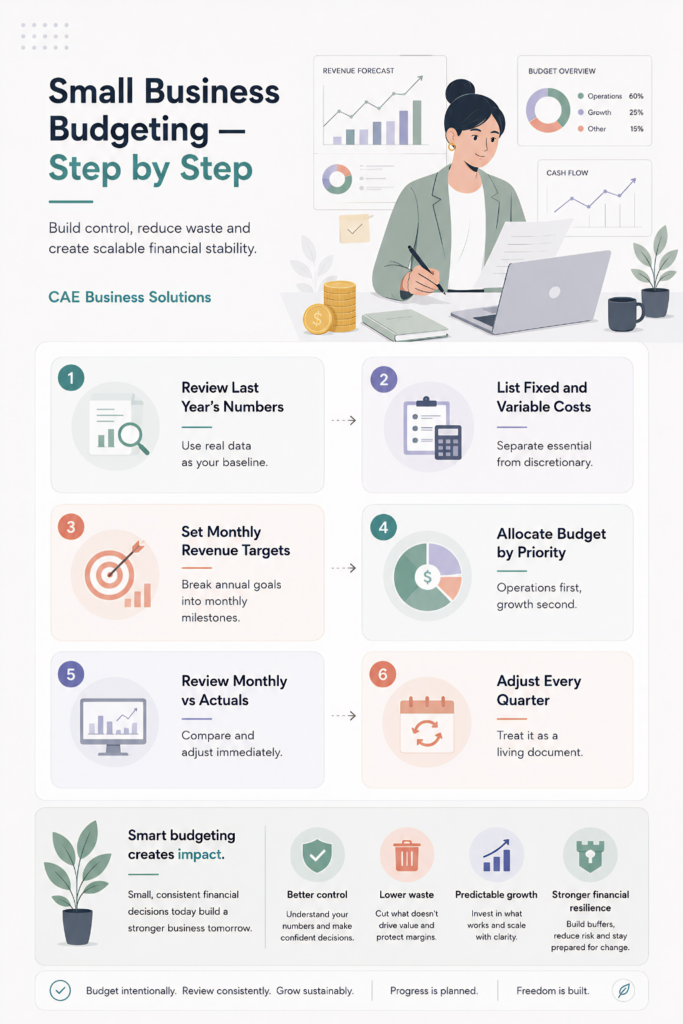
A budget is not a restriction. It is a decision made in advance about where your money goes before emotion, urgency or opportunity makes that decision for you. Most small business budgets fail because they are built on optimism rather than evidence.
Base yours on last year’s actual numbers, not projections you hope to hit. Review it monthly, adjust it quarterly and treat it as a living document rather than an annual formality.

Cash Flow Management That Keeps Your Business Alive
Revenue is vanity. Cash flow is reality. A business can show strong sales figures and still collapse because the money it is owed has not arrived while the money it owes is already due. That gap destroys more small businesses than poor sales ever will.
Managing cash flow starts with visibility. Know exactly what comes in, what goes out and when. Consequently, a simple 13 week cash flow forecast gives you enough runway to make decisions before problems become emergencies rather than after.
Accelerate your inflows and control your outflows deliberately. Invoice immediately upon delivery, chase overdue payments without apology and negotiate extended terms with suppliers wherever possible. Therefore, every day you shorten your payment cycle strengthens your financial position without requiring a single new sale.
For a deeper framework, the financial planning tips for UK SMEs in 2026 provide specific strategies for managing cash flow through growth phases, tax periods and market uncertainty without sacrificing operational stability.
Pricing, Profit Margins and Revenue Diversification
Most small business owners set prices based on what competitors charge or what feels reasonable. Neither approach is financial management. Pricing is a strategic decision that directly determines whether your business generates profit or simply generates activity.
Price for Profit Not for Popularity
Calculate your true cost per product or service including time, overhead and delivery before setting any price. If your margin does not support sustainable growth, the price is wrong regardless of what the market expects.
Know Your Gross and Net Profit Margins
Revenue without margin context is meaningless. Therefore, track both gross and net profit margins monthly and set minimum thresholds below which you will not operate.
Diversify Your Revenue Streams Deliberately
A single revenue stream creates dangerous dependency. Consequently, develop complementary offerings, retainer models or passive income channels that reduce your exposure to any one client or product line.
Connect Pricing to Customer Value
The strongest pricing strategy reflects the outcome you deliver rather than the hours you spend. As we explore in our guide on how to improve customer experience, clients who receive exceptional value rarely challenge the price attached to it.
Evaluating Investments and Managing Financial Risk Like a Pro
Every pound you invest in your business carries an opportunity cost. Spending without evaluating return is not growth strategy. It is financial risk dressed up as ambition. Smart owners evaluate every significant spend against one question, what measurable return will this produce and by when.
A sound investment evaluation process covers:
- Return on investment calculation before committing
- Break even timeline for every major purchase
- Risk assessment against current cash reserves
- Alternative options compared before deciding
- Exit criteria defined if the investment underperforms
Risk management extends beyond investment decisions. Furthermore, it covers insurance coverage, contingency reserves, supplier dependency and client concentration. A business that relies on two clients for 80 percent of its revenue is not a growing business. It is a liability waiting to materialise.
The business growth strategies every SME should implement consistently highlight financial risk management as the discipline that separates businesses that scale confidently from those that stall at the first sign of market pressure.

Financial Management for Small Business: Monitor, Analyse and Adapt
Financial data without regular analysis is just noise. The numbers your business generates every month tell a story about what is working, what is bleeding and what needs to change. Small business owners who read that story consistently make better decisions than those who only check the books when something goes wrong.
Track the Right Metrics Every Month
Focus on the numbers that directly reflect business health. Revenue, gross profit margin, net profit margin, cash flow position and customer acquisition cost give you a complete picture of financial performance without drowning in data.
Compare Performance Against Your Goals
Monthly numbers mean nothing in isolation. Therefore, measure every metric against the targets you set at the start of the year. Variance analysis tells you not just where you stand but why the gap exists and what to do about it.
Use Financial Reports to Drive Decisions
Your profit and loss statement, balance sheet and cash flow statement are not documents for your accountant alone. Consequently, read them monthly, understand what each figure means and use them as the primary input for every significant business decision you make.
Adapt Quickly When the Numbers Signal Change
Financial management is not a static process. Additionally, when metrics consistently miss targets, treat that as intelligence rather than failure. Adjust your pricing, cut underperforming costs, reallocate budget and test new approaches before the problem compounds into a crisis that forces your hand.
Businesses that monitor consistently, analyse honestly and adapt quickly build financial resilience that no market disruption can easily break. The numbers always tell the truth. The only question is whether you are listening.
Numbers Do Not Lie. Most Business Owners Just Stop Listening.
Financial management for small business owners is not a skill reserved for accountants or MBA graduates. It is a discipline that any owner can build with the right framework, the right habits and the willingness to face the numbers without flinching.
Every strategy in this guide exists because financial clarity produces better decisions. Better decisions produce better margins. Better margins produce sustainable growth that does not depend on luck, timing or a single client saying yes.
Start with one area today. Fix your cash flow visibility, review your pricing or build your first honest budget. Consistent financial discipline across every area of your business is ultimately what separates the owners who scale from the ones who survive.
FAQ: Financial Management for Small Business
Financial management for small business owners means making deliberate, informed decisions about money rather than reactive ones. It covers budgeting, cash flow monitoring, pricing strategy, investment evaluation and risk management. The goal is clarity and control over every pound that moves through the business.
Most owners manage finances reactively, checking the bank balance only when a bill arrives. They mix personal and business finances, avoid financial reports and set prices based on gut feeling rather than margins. These habits create a ceiling that ambition alone cannot break through.
Review cash flow weekly, profit and loss monthly and overall financial strategy quarterly. Annual reviews alone are not enough. Markets shift, costs change and opportunities emerge that require faster financial decision making than a once a year review allows.
Track revenue, gross profit margin, net profit margin, cash flow position and customer acquisition cost every month. Compare each figure against your targets and prior periods. These five metrics give you a complete picture of financial health without drowning in unnecessary data.