


Running a business does not mean you are in control of your time. Most UK owners are drowning in tasks they should never have taken on. This guide cuts to the root of why time management for business fails, and gives you the fixes that actually stick without overhauling your entire working life.
Every UK business owner knows the feeling. The day starts with a plan. It ends with the most important work untouched and the inbox somehow fuller than before.
Time management for business is not a productivity problem. It is a decision problem. Most owners are not short of hours. They are short of boundaries, systems and the discipline to protect both.
This guide does not repeat what you already know. It examines why time management for business fails at the root level, exposes the habits quietly wrecking your working day, and gives you fixes that hold up under the real pressure of running a UK business in 2026.
Why Time Management for Business Fails and How to Fix It
Every UK business owner knows the feeling. The day starts with a plan. It ends with the most important work untouched and the inbox somehow fuller than before.
Time management for business is not a productivity problem. It is a decision problem. Most owners are not short of hours. They are short of boundaries, systems and the discipline to protect both.
This guide does not repeat what you already know. It examines why time management for business fails at the root level, exposes the habits quietly wrecking your working day, and gives you fixes that hold up under the real pressure of running a UK business in 2026.

Why Time Management for Business Keeps Failing UK Owners
Most UK business owners do not have a time management problem. They have a prioritisation problem dressed up as one. The House of Commons Library consistently shows that UK productivity lags behind comparable economies. The gap does not come from lack of effort. It comes from effort pointed in the wrong direction.
The most common reasons time management for business breaks down include:
- Treating every task as equally urgent
- Saying yes to meetings that produce nothing
- Checking emails reactively throughout the day
- Confusing being busy with making progress
- Never auditing where time actually goes each week
Business owners who struggle with time rarely lack motivation. They lack structure. Without a clear system, the loudest demand always wins. That is rarely the most important one.
The fix starts with honesty. Track your time for one full week without changing anything. What you find will tell you exactly where the problem lives and what needs to change first.
The Real Cost of Poor Time Management for Business Growth
Time is the one resource you cannot buy back. Every hour lost to low value work is an hour not spent on strategy, clients, or growth. For UK small business owners, that cost compounds quickly.
According to Clockify, the average employee is productive for just 2 hours and 53 minutes each working day. For business owners juggling operations, sales, and delivery simultaneously, that figure is often lower. The rest of the day disappears into meetings, emails, interruptions and context switching.
The financial impact is significant. Time spent on tasks that could be delegated, automated, or eliminated is money spent on work that does not move the business forward. Over a year, that adds up to thousands of pounds in lost opportunity.
Poor time management for business also drives burnout. When owners never feel caught up, stress becomes the operating mode. Decisions suffer. Creativity dries up. The business stalls not because the market changed but because the person running it is running on empty.
Stop Prioritising Tasks and Start Prioritising Outcomes
Most to-do lists are collections of activity, not direction. Crossing items off feels productive. It often is not. The question is not what got done today. It is what moved the business forward.
Shifting from task prioritisation to outcome prioritisation changes everything. Instead of asking what needs doing, ask what needs to happen this week for the business to be in a better position. Work backwards from that answer.
Define Your Weekly Non-Negotiables
Identify three outcomes that must happen each week regardless of what else comes up. These are not tasks. They are results. Protect the time needed to achieve them before anything else gets scheduled.
Apply the 80/20 Rule Ruthlessly
Twenty percent of your daily activities produce eighty percent of your results. Identify that twenty percent and build your day around it. Everything else gets delegated, deferred, or dropped.
Audit Your Task List Weekly
At the end of each week, review what you completed and ask honestly whether it moved the business forward. Tasks that consistently appear without producing results need to be removed from your list permanently.
Time Your High Value Work to Your Peak Hours
Every business owner has hours in the day when they think most clearly. Identify yours and protect them for your highest value work. Do not waste peak hours on email or admin.
Stop Managing a To-Do List and Start Managing a Results List
A results list defines what success looks like for the day or week. It is outcome focused, not activity focused. It keeps your attention on what actually matters rather than what feels urgent.
For a deeper look at how focusing on outcomes drives business improvement, read our guide on improving your business.
Time Management for Business Starts With Ruthless Delegation
The single biggest time management mistake UK business owners make is doing work someone else should be doing. It feels faster to do it yourself. It rarely is. Every task you hold onto that could be handled by someone else is a task keeping you from the work only you can do.
Ruthless delegation is not about offloading work. It is about being honest about where your time creates the most value and protecting it accordingly.

Identify What Only You Can Do
Write down everything you do in a typical week. Separate the tasks that genuinely require your skills, judgement, and relationships from the ones that simply land on your desk out of habit.
Build a Delegation Framework
For every recurring task, ask three questions. Can someone else do this? Can they be trained to do it well? Will the outcome be acceptable without my involvement? If the answer to all three is yes, delegate it.
Delegate Outcomes Not Instructions
When you delegate, define the result you need rather than the steps to get there. Micromanaging defeats the purpose of delegation and creates a dependency that costs you more time than it saves.
Use Technology to Delegate to Systems
Automation is delegation to software. Email sequences, invoicing tools, scheduling apps, and project management platforms can handle repeatable tasks without human involvement. Identify what you do repeatedly and automate it.
Accept Imperfection as the Price of Scale
Delegation requires accepting that others will do things differently and sometimes less perfectly than you would. That is the cost of reclaiming your time. A task done at eighty percent by someone else beats a task done perfectly by you at the expense of your most valuable hours.
Read our guide on building your team to understand how strong leadership makes delegation faster and more effective.
How Time Blocking Transforms a Chaotic Business Day
A calendar with no structure is an open invitation for other people to fill it. Time blocking closes that invitation. It is one of the most effective and most underused time management tools available to UK business owners.
Time blocking means assigning specific tasks or categories of work to fixed periods in your day. Instead of working from a list and deciding in the moment what to do next, you decide in advance. The decision is already made when you sit down to work.
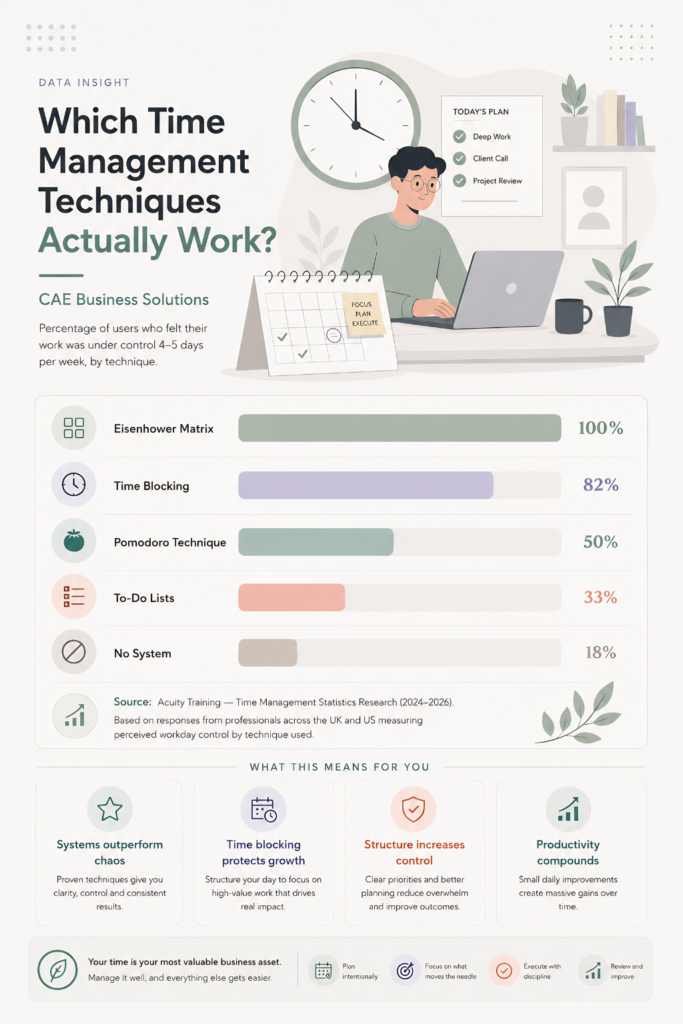
Research from Acuity Training found that only 18% of people have a dedicated time management system in place. The Eisenhower Matrix, when used consistently, resulted in 100% of users feeling their work was under control four or five days a week. Time blocking produces similar results because it removes the constant mental load of deciding what to work on next.
Start by blocking your three most important outcomes for the week. Assign each a specific time slot and treat it like a meeting you cannot cancel. Then block time for email, admin, and calls in separate slots. Keep them contained so they do not bleed into the rest of your day.
The first week will feel rigid. By the third week, it will feel like control.

Time Management for Business in the Age of Digital Distraction
Digital tools were supposed to save time. For most UK business owners, they consume it. Email notifications, Slack messages, social media, and smartphone alerts fragment attention throughout the day and make deep focused work almost impossible.
The average UK employee is productive for less than three hours a day. A significant part of that lost time is traceable directly to digital distraction. For business owners who carry full operational responsibility, the cost is even higher.
Fixing time management for business in a distracted environment requires deliberate boundaries, not willpower.
Turn off all non-essential notifications during your blocked work periods. Check email at fixed times, not continuously. Use separate devices or browser profiles for work and personal use. Create a physical environment that signals to your brain that focused work is happening.
The businesses that consistently outperform their peers are not run by people who work longer hours. They are run by people who protect their attention with the same discipline they apply to their finances. Read our guide on building a successful business to understand the broader foundations that make focused leadership possible.
The Daily Habits That Fix Time Management for Good
Systems beat intentions every time. The business owners who manage their time well do not rely on motivation or discipline alone. They build habits that make good time use the path of least resistance.
The daily habits that make the biggest difference include:
- Starting each day by reviewing your three priority outcomes
- Planning tomorrow before you finish today
- Checking email at set times rather than continuously
- Ending meetings with a clear action and owner
- Doing a five minute end of day review every single day
None of these habits are complicated. That is the point. Complexity is the enemy of consistency. A simple habit done every day produces better results than an elaborate system used occasionally.
The most important habit is the daily review. Five minutes at the end of each working day to assess what was completed, what was not, and why. Over time this practice exposes patterns, identifies recurring time drains, and sharpens your ability to plan the following day more accurately.
Time management for business is not fixed in a single weekend of reorganisation. It is fixed through small deliberate decisions made consistently over weeks and months until they become the default way you operate.
Your Next Move Decides Everything
Most UK business owners will read this and recognise themselves in several sections. Recognition without action changes nothing.
Time management for business improves when you pick one thing and change it this week. Not five things. One. Block your mornings. Delegate one recurring task. Turn off your email notifications for three hours a day. Start there and build from it.
The owners who reclaim their time do not do it all at once. They do it one decision at a time until the decisions compound into a business that runs with intention rather than chaos.
Frequently Asked Questions About Time Management for Business
Because most owners manage tasks rather than outcomes. Without a clear system and protected time, the loudest demand always wins over the most important one.
Track where your time goes for one full week without changing anything. The patterns you find will show you exactly where to start.
Time blocking consistently produces the strongest results. It removes the decision of what to work on next and protects your highest value hours from interruption.
It frees your time for the work only you can do. Every task you hold onto that someone else could handle is time taken away from your most valuable contribution to the business.