


Most businesses rebrand too late, too fast, or for the wrong reasons entirely. By the time they realise it, they have already lost customers who did not understand the change. This guide shows you exactly how to rebrand a business the right way. You will keep what works, fix what does not, and come out with a brand that actually means something.
Most businesses get how to rebrand a business completely wrong. They hire a designer, pick new colours, and launch a fresh logo. Months later the brand still feels broken and the budget is gone. A rebrand that skips strategy is not a rebrand. It is an expensive mistake.
Rebranding and refreshing are not the same thing. A refresh updates the surface. A rebrand rethinks the foundation. Knowing which one your business actually needs is the first decision you have to get right.
This guide walks you through every step. You will learn when to rebrand, where to start, how to bring your customers with you, and how to measure whether it worked.
How to Rebrand a Business Without Making Costly Mistakes
Most rebrand failures are not creative failures. They are strategic ones. Businesses rush to the visible changes before doing the foundational work. The result is a brand that looks different but feels exactly the same. Here is where most businesses go wrong.
Starting With the Logo
The logo is the last thing to change, not the first. A new logo built on an unclear strategy is just decoration. Start with positioning, purpose, and messaging. The visuals follow from there.
Rebranding Without a Clear Diagnosis
Every successful rebrand starts with a specific problem to solve. If you cannot state that problem in one sentence, you are not ready. Clarity of purpose separates a rebrand that works from one that confuses.
Throwing Out What Already Works
Not everything needs to change. Some businesses discard brand equity they have spent years building simply because they wanted something new. Identify what your audience already values and protect it throughout the process.
Leaving Employees Out of the Process
Your team represents your brand every day. If they do not understand the rebrand, your customers will not either. Internal alignment must come before any external announcement.
Launching Without a Transition Plan
Old and new brand assets appearing side by side undermine credibility. Consequently, every touchpoint must be updated before you go public. A rebrand without a rollout plan creates more confusion than the problem it was meant to solve.
How to Know When It Is Time to Rebrand a Business
Most businesses wait too long. By the time they act, customers have already formed a negative perception that takes twice as long to undo. The signs are usually there well before the crisis point. Here is what to look for.
Your Brand Has Outgrown Itself
If your brand was built for a business you no longer are, it is holding you back. A brand that made sense at startup rarely makes sense at scale. When your positioning no longer reflects your offer, it is time to act.
Customer Feedback Is Telling You Something
When customers consistently misunderstand what you do or who you serve, that is not a sales problem. It is a brand problem. Listen to the language your customers use and compare it to the language your brand uses. A gap there is a clear signal.
You Are Losing Ground on Brand Recognition
Strong brands are instantly recognisable. If your audience cannot recall your brand without a prompt, or confuses you with a competitor, your brand recognition has eroded to a point that demands action.
A Refresh Will Not Fix It
A new colour palette or updated font fixes a tired look. It does not fix a broken positioning, a misaligned audience, or a message that no longer resonates. Know the difference before you decide which route to take.
The Cost of Waiting Is Compounding
Every month a misaligned brand stays in market, it costs you customers, conversions, and credibility. Therefore, the longer you wait, the more expensive the fix becomes.
How to Rebrand a Business Starting With a Brand Audit
Before you change anything, you need to understand everything. A brand audit is the diagnostic that tells you what is working, what is broken, and what the gap is between how you see your brand and how your customers see it. Here is how to run one properly.
Audit Your Current Brand Assets
Start with what exists. Collect every touchpoint, your website, social media, sales materials, packaging, and signage. Lay it all out and ask one question: does this look and sound like one brand or many?
Assess Your Strengths, Weaknesses, and Gaps
Be honest about what your brand does well and where it falls short. Survey customers, interview your team, and review your reviews. The patterns that emerge will tell you more than any internal opinion ever could.
Analyse Your Competitive Positioning
Look at where your brand sits relative to your competitors. Are you clearly differentiated or are you blending in? Strong competitive positioning is built on a clear understanding of what your competitors own and what space remains unclaimed.
Identify What to Keep and What to Change
Not everything needs replacing. Some brand elements carry real equity. Others are actively working against you. The audit tells you which is which. Furthermore, this distinction saves significant time and budget in the rebrand process.
Document Everything Before You Move Forward
The audit is only useful if it is recorded. Create a clear report that captures your findings, benchmarks, and recommendations. This becomes the strategic foundation every subsequent rebrand decision is built on.
Defining Your Rebranding Objectives and Target Audience
A rebrand without defined objectives is a creative exercise, not a business strategy. Before a single design decision is made, you need to know exactly what you are trying to achieve and who you are trying to reach. Get these two things right and every subsequent decision becomes easier.
- Clear and measurable rebrand goals
- A defined target audience profile
- Alignment with your overall business strategy
- Success metrics established before you start
- A timeline with accountability at every stage
Your objectives must be specific. “We want a stronger brand” is not an objective. “We want to increase brand recall among 25 to 40 year old business owners by 30 percent within 12 months” is. Vague goals produce vague results. Specific goals produce accountability.
Your target audience defines every creative choice that follows. Typography, tone, colour, and messaging all shift depending on who you are speaking to. Consequently, if your audience has changed since your last brand was built, your rebrand must reflect who they are now, not who they were then.
Aligning the rebrand with your broader business strategy ensures it does not exist in isolation. A rebrand that conflicts with your sales, product, or growth strategy will create internal friction before it ever reaches the customer.
Building a New Brand Identity That Lasts
A brand identity is not a logo. It is the complete system of how your business looks, sounds, and feels at every touchpoint. Get the foundation right and the visuals follow naturally. Rush the visuals without the foundation and you will be back here in three years doing it all again.
Start with purpose, mission, and values. These are not statements for your website footer. They are the decisions that determine every creative choice that follows. A brand built on a clear purpose is consistent without trying to be.
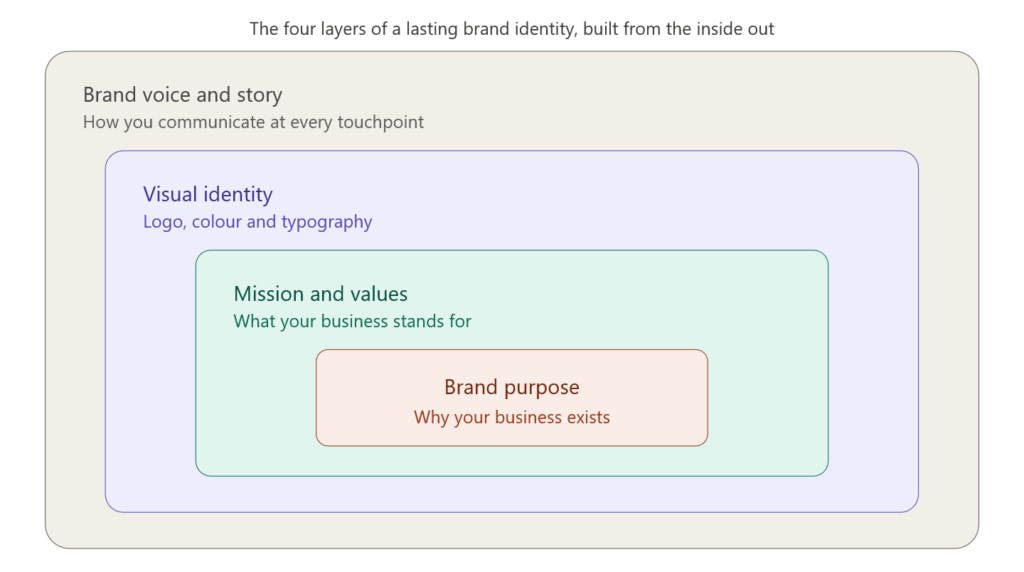
Your visual identity logo, colour, and typography, must reflect what your brand stands for, not just what looks current. Trends fade. A brand built on meaning lasts significantly longer than one built on aesthetics alone.
Brand voice ties everything together. Furthermore, how you write, speak, and communicate is just as recognisable as your logo when it is done consistently. A strong brand story that connects emotionally with your audience turns customers into advocates without a single paid promotion.
Keeping Your Customers Through a Rebrand Without Losing Their Trust
Most rebrands lose customers not because the new brand is wrong but because the change was handled badly. A rebrand that surprises your audience destroys the trust you spent years building.
Start internally. Brief your team fully before any external announcement. If your employees cannot explain the rebrand confidently, your customers will not understand it either.
When you announce a rebrand publicly, lead with the reason behind it. Customers do not resist change. They resist change that feels unexplained. A clear and honest message turns potential resistance into curiosity.
Your longest standing customers deserve a direct message. Acknowledge the change, thank them for their loyalty, and tell them what stays the same. That one gesture protects more trust than any campaign ever could.
Launching and Measuring Your Rebrand for Maximum Impact
A rebrand without a launch plan is just a change of clothes. The rollout is where the strategy either holds together or falls apart. Every touchpoint, your website, social media, signage, email signatures, and sales materials, must be updated before you go public. A partial rollout creates confusion and undermines the credibility of the new brand.
Build a Launch Plan With Clear Deadlines
Assign ownership for every touchpoint update before launch day. Nothing should be left to chance. A checklist with accountable team members and firm deadlines is the difference between a clean launch and a chaotic one.
Roll Out Across Every Touchpoint Simultaneously
Old and new brand assets appearing side by side destroy consistency. Furthermore, consistency is the single most important quality of a successful rebrand. Plan the switchover so everything changes at once.
Track the Right KPIs From Day One
Measure brand awareness, customer sentiment, website traffic, and conversion rates before and after launch. Without a baseline, you cannot prove the rebrand worked. Set your benchmarks before you go live, not after.
Gather Feedback Early and Often
Survey customers, monitor reviews, and listen to your sales team in the first 90 days. The feedback you gather immediately after launch is the most honest signal you will ever get about whether the rebrand landed.
Treat the Launch as the Beginning, Not the End
A rebrand is not a project with a finish line. It is the start of a new brand chapter. Therefore, build a 90 day post-launch review into your plan and use it to make deliberate improvements before perceptions solidify.
A Stronger Brand Does Not Happen by Accident
A rebrand is not a creative decision. It is a strategic one. The businesses that get it right start with a clear diagnosis, align the rebrand with their business goals, bring their team and customers with them, and measure the results with the same rigour they apply to any other business investment.
Every step in this guide exists for a reason. The audit tells you where you stand. The objectives tell you where you are going. The identity gives you the tools to get there. The launch plan makes it real.
Your brand is your most valuable business asset. Treat it accordingly and it will compound in value for years to come.
Frequently Asked Questions About How to Rebrand a Business
Costs vary widely depending on scope. A basic rebrand covering logo and messaging starts from a few thousand pounds. A full rebrand including strategy, identity, and digital rollout can run from tens of thousands upward. The size of your business and the complexity of the change are the two biggest cost drivers.
A simple brand refresh takes four to eight weeks. A full rebrand typically takes three to six months from audit to launch. Complex rebrands involving multiple product lines, markets, or stakeholder groups can take significantly longer. Rushing the process is the most common cause of rebrand failure.
A refresh updates the surface elements of your brand, such as colours, fonts, or logo refinements, without changing the underlying strategy. A rebrand rethinks the positioning, purpose, audience, and identity from the ground up. If your strategy is still sound, a refresh may be enough. If the positioning is broken, a full rebrand is necessary.