


Kodak invented the digital camera and still went bankrupt. Blockbuster had the chance to buy Netflix and passed. Both had the resources to survive. What they lacked, however, were business improvement strategies embedded deep enough to matter when it counted. This guide shows you what those strategies look like, how to build them into your business, and why starting today is already later than you think.
The most dangerous business improvement strategies are the ones that never get implemented. Most businesses talk about improving. They schedule the meeting, write the plan, and then return to doing exactly what they did before. That is not improvement. That is expensive procrastination.
The companies that grow consistently share one trait. They treat improvement not as a response to problems but as a permanent operating discipline. Consequently, they spot opportunities earlier, adapt faster, and build advantages that competitors cannot easily copy.
This guide shows you exactly what that looks like in practice. You will learn how to build a culture of innovation, streamline your processes, develop your people, and make improvement a permanent part of how your business operates.
What Business Improvement Strategies Actually Mean in Practice
Most business owners have heard the term. Far fewer have a clear picture of what it actually involves day to day. Business improvement strategies are not about transformation programmes or consultant-led overhauls. They are about deliberate, consistent action taken at every level of the business. Here is what that covers.
- A clear diagnosis of what is not working
- Processes that are regularly reviewed and refined
- A team that is encouraged to surface problems early
- Decisions driven by data rather than habit
- A culture where improvement is expected, not exceptional
Most improvement efforts fail because they are reactive. Something breaks, a complaint arrives, or a competitor pulls ahead. Only then does the business respond. By that point, however, the damage is already done and the response is rushed.
Proactive improvement works differently. It does not wait for a crisis to trigger action. Instead, it builds review, reflection, and refinement into the normal rhythm of the business. As a result, problems are caught earlier, opportunities are spotted faster, and the business builds genuine resilience over time.
When business improvement strategies are working, you will not always see a dramatic moment of change. What you will see, however, is a business that gets incrementally better every quarter without fanfare.
Building a Culture of Innovation From the Inside Out
Strategy without culture is just a document. The businesses that improve consistently are not the ones with the best plans. They are the ones where improvement is expected behaviour at every level, from the boardroom to the front line. Culture, therefore, is where business improvement actually lives.
Encouraging ideas at every level is not about suggestion boxes or innovation days. It is about creating an environment where people feel safe enough to speak up. When employees know their input is valued, they surface problems earlier and solutions faster. Consequently, the business improves without always needing leadership to drive it.
The cost of punishing failure is often invisible until it is too late. When mistakes are penalised rather than examined, people stop experimenting. Furthermore, they stop improving. The most innovative cultures treat failure as data, not a discipline issue.
What these cultures share is a commitment to lasting improvement that goes beyond individual initiatives. They build systems, habits, and expectations that make progress the default rather than the exception.
Business Improvement Strategies That Start With Your Processes
Most businesses lose more time and money to broken processes than to any external threat. The inefficiencies are rarely dramatic. They show up as duplicated steps, manual tasks that someone should have automated years ago, and approval chains that serve no clear purpose. Here is where to start fixing them.
Map Where Time and Money Are Actually Going
Before you improve a process, you need to understand it. Walk through every key workflow in your business and document what actually happens, not what the manual says should happen. The gap between the two is almost always where the waste hides.
Apply Lean Principles to Eliminate Waste
Lean thinking is not just for manufacturers. Any business can use it. Ask whether each step in a process adds value for the customer. If it does not, eliminate waste and cut it. Businesses that do this consistently see significant financial impact within months.
Bring Agile Thinking Into Non-Tech Businesses
Agile is not a technology concept. It is a way of working in shorter cycles, gathering feedback quickly, and adjusting before problems compound. Consequently, any business can apply this thinking to marketing, operations, customer service, and product development.
Build a Regular Process Audit Into Your Calendar
A process that worked twelve months ago may not work today. Therefore, schedule a quarterly review of your core workflows. Furthermore, involve the people who run them daily. They always know where the friction is.
Investing in Your People as a Business Improvement Strategy
Most businesses underinvest in their people and then wonder why performance plateaus. Your team is the most underleveraged asset in your business. The systems, processes, and strategies you build are only as strong as the people who run them. Here is what investing in them actually looks like.
- Regular training and skills development
- Clear career progression pathways
- A learning culture that rewards curiosity
- Mentoring and coaching at every level
- Retention strategies built around growth
Training compounds over time in the same way interest does. A team member who receives consistent development becomes measurably more valuable every year. Furthermore, businesses that invest in learning retain better talent, reduce recruitment costs, and build institutional knowledge that competitors cannot easily replicate.
Retention, however, is the real prize. High turnover drains resources, disrupts momentum, and costs significantly more than most business owners realise. Consequently, the businesses that grow fastest are usually the ones that hold onto their best people longest by giving them reasons to stay.
Building a winning team is therefore not just a leadership challenge. It is one of the most impactful business improvement strategies available to any owner at any stage of growth.
Using Data to Drive Business Improvement Strategies
Most business owners make decisions based on gut instinct. That works in the early days. However, as a business grows, instinct alone creates blind spots that quietly cost you revenue, customers, and time.
The KPIs in the table above give you a starting point. However, tracking numbers without acting on them is just administration. The goal, therefore, is to build a habit of reviewing your data regularly and asking one question after every review: what does this tell us to do differently?
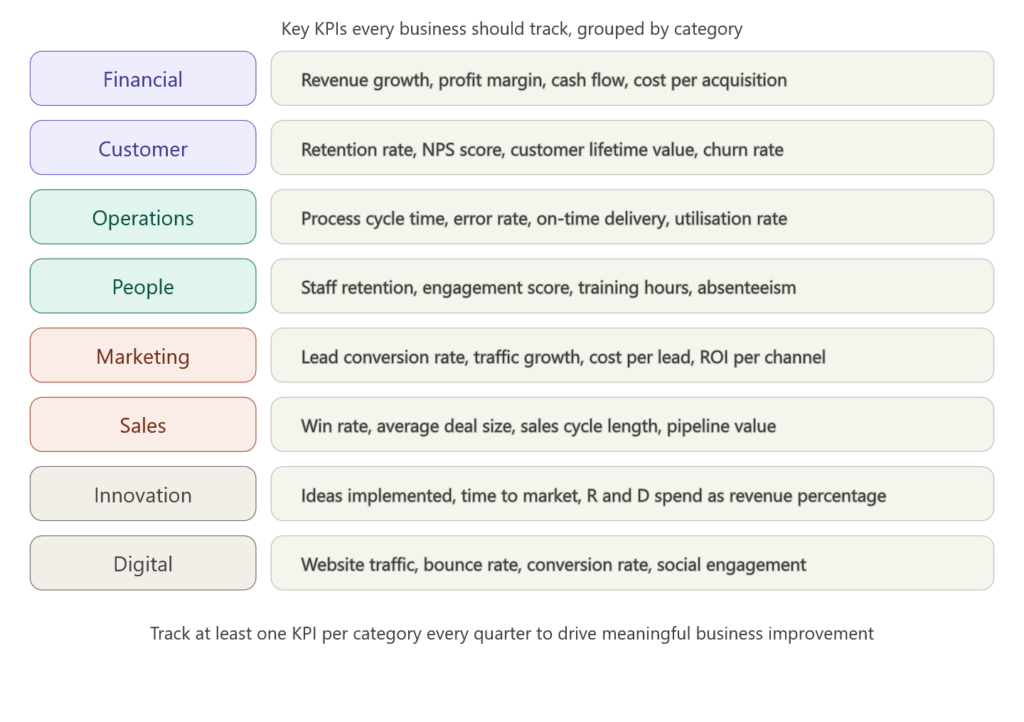
Turning data into decisions requires a simple system. Set a monthly review date, assign ownership of each metric, and agree on the threshold that triggers action. Furthermore, link your strategic priorities to your KPIs so every number you track connects directly to a business outcome you actually care about.
The businesses that improve fastest are not the ones with the most data. They are the ones that act on the right data consistently.
Collaboration and External Partnerships as Growth Levers
No business improves in isolation. The fastest growing companies actively seek knowledge, perspective, and opportunity from outside their own walls. Collaboration is not a soft concept. It is a deliberate growth strategy. Here is what it looks like in practice.
- Industry peer groups and mastermind networks
- Mentorship from experienced business leaders
- Strategic supplier and vendor partnerships
- Cross-industry collaborations that spark innovation
- Joint ventures that share risk and accelerate results
Learning from peers who face the same challenges compresses your learning curve significantly. Furthermore, the insights you gain from someone who has already solved a problem you are wrestling with are worth more than months of trial and error on your own.
Strategic partnerships take that principle further. The right partnership brings complementary skills, shared audiences, and combined resources that neither business could access alone. Consequently, businesses that build strong external relationships improve faster, reach further, and build resilience that purely independent operators rarely achieve.
Business Improvement Strategies That Stick Long Term
Most improvement initiatives start well. The energy is high, the plan looks solid, and everyone is engaged. Six weeks later, however, the old habits return and the initiative quietly disappears. Lasting improvement does not come from motivation. It comes from systems. Here is how to build them.
Identify Why Previous Initiatives Failed
Before you launch anything new, examine what happened to the last improvement effort. Most fade because they relied on enthusiasm rather than structure. Consequently, understanding the failure point is the first step toward building something that lasts.
Replace Motivation With Systems
Motivation fluctuates. Systems do not. Build improvement into your regular operating rhythm through scheduled reviews, standing agenda items, and clear ownership. Furthermore, when improvement becomes part of how the business runs, it no longer depends on anyone remembering to prioritise it.
Celebrate Small Wins Publicly
Momentum builds on visible progress. When a team member identifies a process improvement or a cost saving, recognise it openly. As a result, others see that improvement is noticed and valued, which reinforces the behaviour across the entire business.
Assign Clear Ownership to Every Initiative
Every improvement effort needs one person accountable for its progress. Shared responsibility, in practice, means no responsibility. Therefore, name the owner, set the deadline, and review progress on a fixed schedule.
Build a 90 Day Review Into Your Business Calendar
Long term improvement requires regular reflection. A quarterly review of your key initiatives, metrics, and processes keeps the business honest. Moreover, it creates a natural moment to stop what is not working and double down on what is.
The Cost of Standing Still Is Higher Than You Think
Every day a business does not improve, a competitor does. That gap compounds quietly until it becomes a crisis. Improvement is not a project you schedule when things slow down. It is a strategic choice you make every day, in every part of the business.
The businesses that last build cultures of innovation, streamline their processes, invest in their people, track the right data, and actively seek outside perspective. None of those things happen by accident. Furthermore, none of them require a large budget. They require commitment and consistency above all else.
Start with one area. Build the habit. Then expand it.
Frequently Asked Questions: Business Improvement Strategies
The most effective strategies combine process improvement, people development, and data-driven decision making. Businesses that improve consistently focus on all three rather than treating them as separate initiatives. Furthermore, embedding improvement into daily operations produces far better results than running isolated projects.
Every business needs improvement. The question is where to start. Look for recurring problems, declining margins, high staff turnover, or stagnating revenue. These are reliable signals that something in your operations, culture, or strategy needs attention.
Improvement refines what already exists. Innovation creates something new. Both matter, but most businesses benefit more from improving their existing operations before chasing new ideas. As a result, improvement builds the foundation that makes innovation sustainable.
Some improvements, such as process changes, produce results within weeks. Others, such as culture shifts and people development, take six to twelve months to show meaningful impact. Consequently, set short, medium, and long term expectations from the outset and measure progress at each stage.